Aluminum Die Casting Defects: Porosity, Shrinkage and How to Prevent Them
Time :2026-06-07 Hits:1001
Aluminum die casting is widely used in automotive, EV battery housings, industrial equipment, and precision engineering due to its high efficiency and excellent dimensional stability.
However, like any high-pressure metal forming process, aluminum die casting can produce internal and surface defects if process control is not properly managed.
Among all defect types, porosity and shrinkage are the most critical and most common issues affecting mechanical strength, sealing performance, and long-term reliability.
This article explains the root causes of these defects and how experienced die casting manufacturers prevent them through engineering and process optimization.
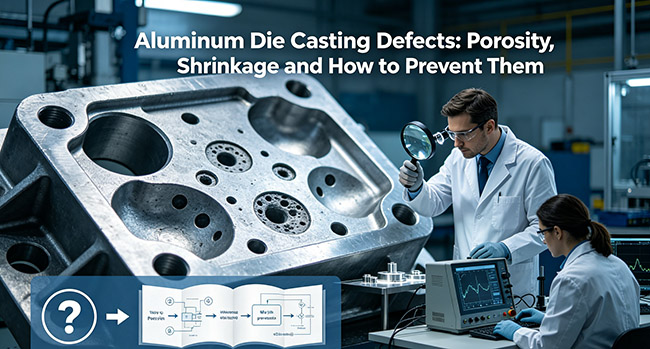
1. Why Defects Occur in Aluminum Die Casting
Die casting involves injecting molten aluminum into a steel mold under high pressure.
During this process, several physical phenomena occur simultaneously:
-
Rapid metal solidification
-
High-speed cavity filling
-
Gas entrapment risk
-
Uneven cooling rates
-
Complex flow behavior inside the mold
If any of these factors are not properly controlled, internal or surface defects may form.
2. Porosity in Aluminum Die Casting
2.1 What Is Porosity?
Porosity refers to small gas pockets or voids trapped inside the casting structure.
These voids can significantly affect:
-
Mechanical strength
-
Pressure tightness (leakage risk)
-
Fatigue resistance
-
Surface finishing quality after machining
2.2 Types of Porosity
There are three main types of porosity in aluminum die casting:
Gas Porosity
Caused by trapped air or gas during high-speed injection.
Shrinkage Porosity
Caused by volume contraction during solidification.
Pinhole Porosity
Very small surface-connected pores, often visible after machining.
2.3 Root Causes of Porosity
Porosity is typically caused by a combination of process factors:
-
Poor mold venting design
-
Excessive injection speed
-
Turbulent metal flow
-
Improper gate design
-
High moisture in molten alloy
-
Insufficient vacuum assistance
2.4 How to Prevent Porosity
Experienced die casting manufacturers use multiple strategies:
-
Vacuum-assisted die casting systems
-
Optimized gating and runner design
-
Controlled injection speed profile
-
Proper mold venting channels
-
Degassing of molten aluminum
-
Simulation-based mold flow analysis (CAE)
In high-performance applications such as EV battery housings or transmission components, vacuum die casting is often essential.
3. Shrinkage Defects in Aluminum Die Casting
3.1 What Is Shrinkage?
Shrinkage occurs when molten aluminum solidifies and contracts unevenly, leaving internal voids or cavities.
Unlike gas porosity, shrinkage is related to thermal behavior, not trapped air.
3.2 Where Shrinkage Usually Occurs
Shrinkage defects commonly appear in:
-
Thick wall sections
-
Hot spots with slow cooling
-
Junctions of multiple material flows
-
Areas with poor feeding of molten metal
3.3 Root Causes of Shrinkage
The main causes include:
-
Non-uniform wall thickness
-
Poor thermal gradient control
-
Improper gating design
-
Lack of directional solidification
-
Inadequate cooling channel layout
3.4 How to Prevent Shrinkage
Shrinkage control is mainly an engineering design issue.
Effective prevention methods include:
-
Designing uniform wall thickness
-
Using directional solidification principles
-
Optimizing cooling channel placement
-
Adding proper riser and feeding paths (for applicable processes)
-
Mold flow simulation (CAE) before tooling
-
Reducing thermal mass concentration in critical zones
4. Role of Mold Design in Defect Control
Mold design is the most important factor in preventing both porosity and shrinkage.
A well-designed die casting mold can significantly reduce defect rates by controlling:
-
Metal flow direction
-
Cooling speed distribution
-
Pressure transmission
-
Air evacuation paths
Modern manufacturers rely heavily on:
-
3D CAD mold design systems
-
Flow simulation software
-
Thermal analysis models
At the engineering level, mold design determines up to 70% of final casting quality.
5. Process Control: From Melting to Production
Even with perfect mold design, process control is still critical.
Key process control factors include:
5.1 Melting Control
-
Alloy composition consistency
-
Degassing treatment
-
Temperature stability
5.2 Injection Control
-
First-stage slow filling
-
Second-stage high pressure packing
-
Controlled injection velocity curve
5.3 Cooling Control
-
Mold temperature balance
-
Cycle time optimization
-
Cooling channel efficiency
6. Quality Inspection Methods
To ensure defect-free production, manufacturers use multiple inspection methods:
-
X-ray inspection for internal porosity
-
CMM measurement for dimensional accuracy
-
Pressure testing for sealing performance
-
Metallographic analysis for structure verification
-
Leak testing for housing components
For automotive and EV applications, X-ray inspection is often mandatory.
7. Why Defects Matter in Real Applications
Even small defects can lead to serious performance issues:
-
EV battery housings → leakage or safety risk
-
Automotive transmission parts → fatigue failure
-
Industrial housings → pressure loss or cracking
-
Electronics enclosures → sealing failure
That is why high-end applications require strict process control and certified manufacturing systems such as IATF 16949.
8. How Shenzhen Jinyuanfu Controls Die Casting Quality
Shenzhen Jinyuanfu Metal Products Co., Ltd., established in 2003, specializes in high-precision aluminum, zinc, and magnesium die casting solutions.
Our quality control system includes:
-
Mold flow simulation before tooling
-
Precision mold manufacturing up to 0.01mm accuracy
-
Vacuum die casting capability
-
Full CNC post-machining control
-
X-ray inspection and CMM measurement
-
ISO 9001 / IATF 16949 / ISO 14001 certified systems
With over 20 years of experience and a 10,000+ square meter production facility, we provide stable and engineering-driven die casting solutions for global customers in automotive, EV, and industrial sectors.
9. Conclusion: Defects Are Not Random—They Are Controllable
Aluminum die casting defects such as porosity and shrinkage are not unavoidable problems.
They are the result of:
-
Mold design quality
-
Process parameter control
-
Material handling
-
Engineering capability
With proper design, simulation, and process control, defect rates can be significantly reduced or eliminated in mass production.
The key is not only manufacturing equipment—but engineering expertise behind it.
PREV:China vs Europe Aluminum Die Casting: Cost, Quality and Lead Time Comparison
NEXT:How to Choose a Reliable Aluminum Die Casting Supplier in China
Related News
- How to Choose a Reliable Aluminum Die Casting Supplier in China
- Aluminum Die Casting Defects: Porosity, Shrinkage and How to Prevent Them
- China vs Europe Aluminum Die Casting: Cost, Quality and Lead Time Comparison
- EV Battery Housing Manufacturing: Why Aluminum Die Casting Is the Best Solution
- Aluminum Die Casting Cost Breakdown: What You Are Really Paying For
- How to Choose the Right Aluminum Die Casting Supplier: A Practical Guide for Engineering and Procurement Teams
- Minimum Order Quantity (MOQ) in China Aluminum Casting: What Buyers Need to Know Before Requesting a Quote
- German Aluminum Die Casting Supplier Alternative: High-Quality China Manufacturing Solutions from Shenzhen Jinyuanfu