Aluminum Die Casting Cost Breakdown: What You Are Really Paying For
Time :2026-06-07 Hits:0
Understanding aluminum die casting cost is the first step to making better sourcing decisions.
Many procurement teams compare quotations from different suppliers and notice significant price differences—sometimes 20% to 50% for the same part.
However, in aluminum die casting projects, price differences are rarely about profit margins alone. They are usually driven by differences in tooling design, production process, quality requirements, and engineering capability.
This article explains the real cost structure behind aluminum die casting and helps you understand what you are actually paying for when sourcing from a China aluminum die casting manufacturer.
1. Why Aluminum Die Casting Prices Are Not Standardized
Unlike off-the-shelf products, aluminum die casting parts are custom-engineered components.
Each project has different requirements:
-
Part geometry and complexity
-
Material selection (ADC12, A380, etc.)
-
Surface finish requirements
-
Tolerance and dimensional accuracy
-
Annual production volume
-
Post-machining requirements
Because of these variables, there is no universal “price per kg” or fixed unit cost in die casting manufacturing.
Instead, total cost is built from multiple engineering and production factors.
2. The Real Structure of Aluminum Die Casting Cost
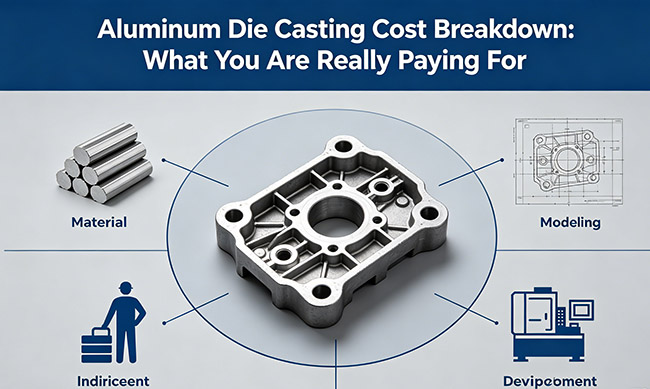
In most industrial projects, aluminum die casting cost can be divided into five main components:
2.1 Tooling (Mold) Cost
Tooling is usually the first and most important cost element.
A die casting mold typically includes:
-
Mold base steel
-
Core and cavity machining
-
Sliding systems (if needed)
-
Cooling channels
-
Ejection systems
Tooling cost can vary widely depending on:
-
Part complexity
-
Number of cavities
-
Mold life requirement
-
Steel grade selection
In real projects, tooling cost often represents a significant upfront investment, especially for automotive and EV components.
However, it is important to understand that tooling is not just a cost—it is a long-term production asset that determines part stability and unit cost efficiency.
2.2 Raw Material Cost (Aluminum Alloy)
Aluminum alloy is the second key cost factor.
Common die casting alloys include:
-
ADC12 (widely used in Asia)
-
A380 (common in global automotive applications)
Material cost is influenced by:
-
Global aluminum price fluctuations
-
Scrap rate during production
-
Alloy specification requirements
In high-volume production, even small material differences can significantly impact total project cost.
2.3 Die Casting Production Cost
This includes:
-
Machine operation time
-
Labor cost
-
Energy consumption
-
Cycle time per shot
-
Automation level
A key factor here is cycle time.
For example:
A part with optimized geometry may have a cycle time of 30–40 seconds, while a more complex design may require significantly longer production time. Over thousands of cycles, this directly affects unit cost.
2.4 CNC Machining and Secondary Processing
Many aluminum die casting parts require post-machining to meet precision requirements.
Typical processes include:
-
Drilling
-
Tapping
-
Milling
-
Surface finishing preparation
Machining cost depends on:
-
Tolerance requirements
-
Number of machined surfaces
-
Fixture complexity
-
Batch size
In some cases, machining cost can exceed casting cost if the design is not optimized for manufacturing.
2.5 Surface Treatment and Quality Inspection
Surface finishing options include:
-
Sand blasting
-
Powder coating
-
Anodizing
-
Chemical treatment
Quality inspection may involve:
-
CMM measurement
-
X-ray inspection for internal porosity
-
Leak testing (for housings)
These steps are essential for automotive, EV, and industrial applications where reliability is critical.
3. Why Supplier Quotations Can Differ by 30–50%
In real sourcing projects, price differences between suppliers are often caused by engineering decisions rather than profit margins.
The most common reasons include:
-
Different mold design strategies
-
Different assumptions about tooling life
-
Variation in machining allowance
-
Different scrap rate expectations
-
Different quality control standards
-
Different automation levels
For example, a supplier using a simplified tooling design may offer a lower price, but this can lead to higher maintenance cost and lower mold life in long-term production.
4. The Hidden Cost Most Buyers Overlook: Design Optimization
One of the most important but often ignored cost drivers is product design.
Through Design for Manufacturing (DFM), experienced engineers can significantly reduce total project cost.
Common optimization areas include:
-
Wall thickness consistency
-
Reduction of unnecessary undercuts
-
Improved draft angles
-
Simplified machining features
-
Better gating system design
In many real projects, proper DFM optimization can reduce tooling cost and improve production yield at the same time.
This is often more effective than negotiating unit price alone.
5. A Real-World Example from an EV Project
In a recent electric motor housing project for a European customer, the initial quotation from multiple suppliers varied significantly.
After engineering review, we identified several design inefficiencies:
-
Unnecessary side cores
-
Non-uniform wall thickness
-
Excess machining requirements
After optimization:
-
Tooling complexity was reduced
-
Production cycle time improved
-
Scrap rate decreased
As a result, the customer achieved a more stable production cost structure and improved long-term scalability.
This type of engineering-driven cost reduction is often more valuable than short-term price negotiation.
6. Shenzhen Jinyuanfu Manufacturing Capability
Shenzhen Jinyuanfu was established in 2003 and specializes in aluminum die casting, zinc die casting, mold manufacturing, and CNC machining services.
Our production base covers 10,000 square meters with more than 200 employees.
We are certified under:
-
ISO 9001 Quality Management System
-
IATF 16949 Automotive Quality System
-
ISO 14001 Environmental Management System
Our engineering team focuses on helping customers optimize cost structure through design improvement, process selection, and production planning—not just providing unit pricing.
7. Conclusion: Die Casting Cost Is a System, Not a Number
Aluminum die casting cost is not a simple unit price.
It is the result of multiple interconnected factors:
-
Tooling design
-
Material selection
-
Production efficiency
-
Machining requirements
-
Quality standards
-
Engineering optimization
For procurement teams, the most effective way to reduce cost is not only comparing suppliers, but understanding the engineering behind the quotation.
A well-designed die casting project can reduce total cost while improving stability, scalability, and product performance.
Related News
- How to Choose a Reliable Aluminum Die Casting Supplier in China
- Aluminum Die Casting Defects: Porosity, Shrinkage and How to Prevent Them
- China vs Europe Aluminum Die Casting: Cost, Quality and Lead Time Comparison
- EV Battery Housing Manufacturing: Why Aluminum Die Casting Is the Best Solution
- Aluminum Die Casting Cost Breakdown: What You Are Really Paying For
- How to Choose the Right Aluminum Die Casting Supplier: A Practical Guide for Engineering and Procurement Teams
- Minimum Order Quantity (MOQ) in China Aluminum Casting: What Buyers Need to Know Before Requesting a Quote
- German Aluminum Die Casting Supplier Alternative: High-Quality China Manufacturing Solutions from Shenzhen Jinyuanfu