EV Battery Housing Manufacturing: Why Aluminum Die Casting Is the Best Solution
Time :2026-06-07 Hits:0
As electric vehicles (EVs) continue to grow globally, battery system design has become one of the most critical engineering challenges in automotive manufacturing.
Among all structural materials and manufacturing processes, aluminum die casting has become the leading solution for EV battery housings and battery trays due to its balance of lightweight performance, thermal management, structural strength, and mass production efficiency.
This article explains why aluminum die casting is widely adopted in EV battery housing manufacturing and how suppliers in China support global EV programs.
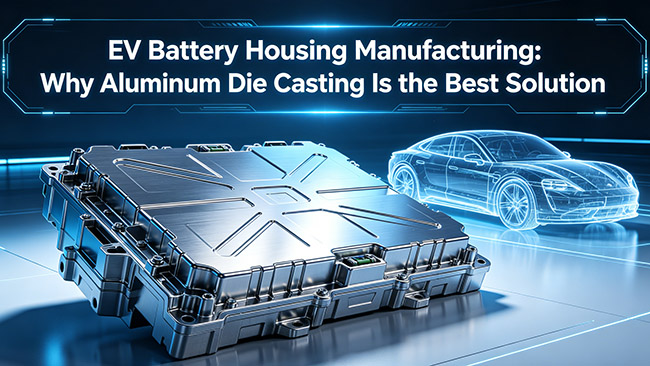
1. Why EV Battery Housing Requires Advanced Manufacturing Solutions
EV battery housings are not simple structural parts. They must perform multiple functions simultaneously:
Protect battery modules from impact
Provide structural rigidity for the vehicle body
Support thermal management systems
Ensure electrical insulation safety
Maintain dimensional stability over long-term use
Because of these requirements, traditional manufacturing methods such as welding steel structures or assembling multiple stamped parts often lead to:
High weight
Complex assembly processes
Increased leakage risk
Higher long-term cost
This is why manufacturers are shifting toward integrated aluminum solutions.
2. Why Aluminum Die Casting Is the Preferred Technology
Aluminum die casting has become the preferred process for EV battery housings due to its ability to integrate complex structures into a single component.
Key advantages include:
2.1 Lightweight Structure
Aluminum alloys are significantly lighter than steel.
This directly improves:
Vehicle driving range
Energy efficiency
Overall EV performance
Weight reduction is one of the most important design goals in EV engineering.
2.2 High Structural Strength
Despite being lightweight, aluminum die cast structures can provide excellent mechanical strength when properly designed.
This allows battery housings to withstand:
Crash impact forces
Vibration during driving
Long-term fatigue loading
Structural reliability is essential for passenger safety.
2.3 Integrated Design (Fewer Parts)
One of the biggest advantages of die casting is part integration.
Instead of assembling dozens of stamped and welded parts, aluminum die casting allows engineers to design:
One-piece battery tray structures
Integrated cooling channels
Built-in mounting features
This reduces:
Assembly cost
Welding defects
Leakage risk
Production complexity
2.4 Thermal Management Efficiency
Battery performance is highly dependent on temperature control.
Aluminum offers excellent thermal conductivity, making it ideal for:
Heat dissipation
Cooling plate integration
Thermal stability of battery modules
Proper thermal design directly improves battery lifespan and safety.
3. Typical Manufacturing Process for EV Battery Housing
A complete aluminum die casting EV battery housing project usually includes:
Step 1: Engineering Design Review (DFM)
Engineers analyze:
Wall thickness distribution
Structural reinforcement points
Mold flow behavior
Machining requirements
Design optimization at this stage has a major impact on final cost and quality.
Step 2: Tooling Design and Mold Manufacturing
EV battery housing molds are typically large and complex.
They may include:
Multiple sliding cores
High-precision cavity systems
Cooling channel optimization
Long-life tool steel selection
Tooling quality directly determines production stability.
Step 3: High-Pressure Die Casting Production
Aluminum alloy is injected into the mold under high pressure.
Key process controls include:
Injection speed
Mold temperature control
Cooling time
Vacuum system usage (for porosity reduction)
Stable process control is essential for structural consistency.
Step 4: CNC Machining and Assembly Features
After casting, critical surfaces are machined to meet tolerance requirements.
Typical machining includes:
Sealing surfaces
Mounting holes
Battery module interfaces
Step 5: Surface Treatment and Testing
To ensure performance and durability:
Surface coating or anodizing may be applied
Leak testing is performed for sealing performance
X-ray inspection checks internal porosity
CMM ensures dimensional accuracy
4. Key Engineering Challenges in EV Battery Housing
Although aluminum die casting offers many advantages, EV battery housing production also presents engineering challenges:
4.1 Porosity Control
Gas porosity can affect sealing performance.
Solutions include:
Vacuum die casting systems
Optimized gating design
Controlled cooling rates
4.2 Large-Scale Mold Design
Battery housings are large components, requiring:
High-tonnage die casting machines
Thermal stability control
Reinforced mold structures
4.3 Dimensional Stability
Long parts require strict control of:
Shrinkage
Warpage
Thermal deformation
Proper mold design and process control are essential.
5. Why Global OEMs Source EV Battery Housing from China
China has become a major sourcing hub for EV aluminum die casting due to several structural advantages:
Mature die casting supply chain
Strong mold manufacturing capability
Competitive tooling and production cost
Fast engineering iteration cycles
Integrated CNC + casting + finishing systems
For many global EV programs, China suppliers are not only cost-efficient but also highly responsive during early-stage development.
6. Shenzhen Jinyuanfu Manufacturing Capability
Shenzhen Jinyuanfu, established in 2003, provides integrated aluminum die casting solutions for automotive and EV industries.
Our manufacturing capabilities include:
Aluminum die casting production
Zinc die casting
Mold design and tooling manufacturing
CNC precision machining
Surface finishing and assembly
Factory scale:
10,000 square meters production facility
Over 200 employees
Full in-house engineering support
Certifications:
ISO 9001 Quality Management System
IATF 16949 Automotive Quality System
ISO 14001 Environmental Management System
We support global EV customers with engineering-driven manufacturing solutions focused on cost optimization, structural design improvement, and mass production stability.
7. Conclusion: EV Battery Housing Is a System Engineering Product
EV battery housing is not just a casting part—it is a system-level engineering component involving structure, thermal management, safety, and manufacturability.
Aluminum die casting has become the preferred solution because it integrates multiple functions into a single structure while maintaining scalability for mass production.
For EV manufacturers, the key to success is not only selecting the right material, but also choosing the right manufacturing partner with strong engineering capability and process control.
PREV:Aluminum Die Casting Cost Breakdown: What You Are Really Paying For
NEXT:China vs Europe Aluminum Die Casting: Cost, Quality and Lead Time Comparison
Related News
- How to Choose a Reliable Aluminum Die Casting Supplier in China
- Aluminum Die Casting Defects: Porosity, Shrinkage and How to Prevent Them
- China vs Europe Aluminum Die Casting: Cost, Quality and Lead Time Comparison
- EV Battery Housing Manufacturing: Why Aluminum Die Casting Is the Best Solution
- Aluminum Die Casting Cost Breakdown: What You Are Really Paying For
- How to Choose the Right Aluminum Die Casting Supplier: A Practical Guide for Engineering and Procurement Teams
- Minimum Order Quantity (MOQ) in China Aluminum Casting: What Buyers Need to Know Before Requesting a Quote
- German Aluminum Die Casting Supplier Alternative: High-Quality China Manufacturing Solutions from Shenzhen Jinyuanfu